


Pilotstudie (2015-2018)
In einer Pilotstudie von Mulfinger und Kolleg:innen (war eine Studie zu IWS für Jugendliche) wurden die Auswirkungen des IWS-Programms zu verschiedenen Outcomes untersucht. Die Ergebnisse zeigen eine Reduzierung des Stigmastress (zu T1) und erhöhte Lebensqualität (zu T2). Außerdem zeigen sich positive Auswirkungen auf Selbststigmatisierung, offenlegungsbezogene Belastung, Geheimhaltung, Hilfesuche, Einstellungen zu Offenlegung, Recovery und depressiven Symptomen. Die veröffentlichen Studienergebnisse finden Sie hier (verlinken zu https://pubmed.ncbi.nlm.nih.gov/29205343).
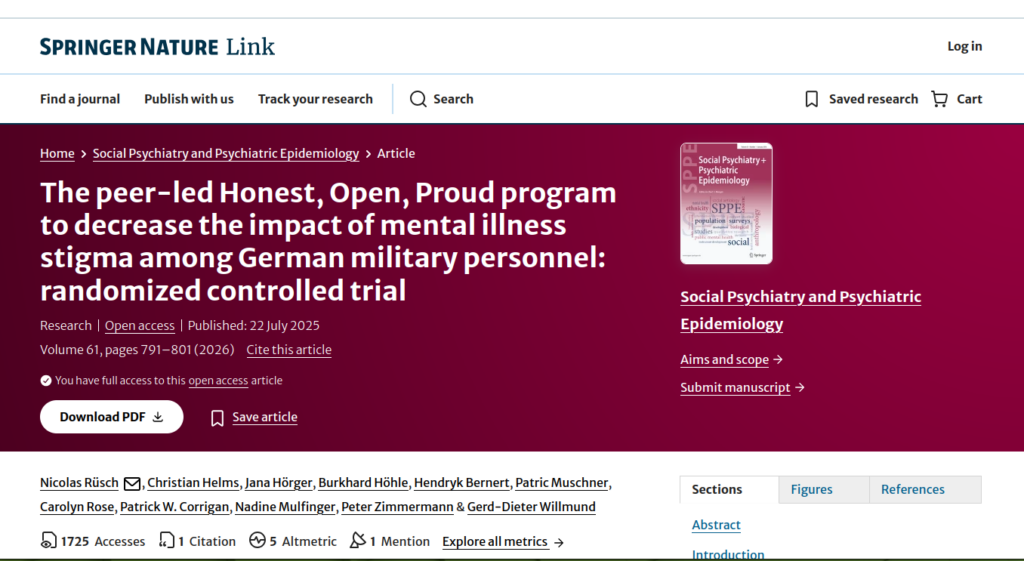
Springer.com: https://link.springer.com/article/10.1007/s00127-025-02960-x
Diese Arbeit, frei verfügbar (open access) gibt (englischsprachig) einen Überblick zu Konzept & Inhalt von IWS und zur Wirksamkeit (Zusammenfassung aller kontrollierter Evaluationsstudien bis 2020), d.h. Effekte auf Stigmastress und Selbststigma.
Studie EI-IWS (2023-2025)
In der durch das Bundesministerium für Gesundheit geförderten Studie „EI-IWS“ wurde die Wirksamkeit (Effektivität) von IWS gegen Selbststigma und die Umsetzbarkeit (Implementierung) unter Alltagsbedingungen untersucht.
Aktuell arbeiten wir an der Auswertung der Daten. Veröffentlichungen dazu finden Sie demnächst hier.
https://www.sciencedirect.com/science/article/pii/S2666776226001638
Under a Creative Commons license
Open access
Real-World Effectiveness of the Peer-Led Honest, Open, Proud Programme for Self-Stigma Among Adults With Mental Illness: A Pragmatic, Multicentre, Randomised Controlled Trial
Author links open overlay panel
Nicolas Rüsch ab,Claudia Schulz ab, Chiara Weisshap ab, Carolin Knoke ab, Julia Wöhrle ab, Kathrin Reichmann ab, Ronja Büchner , Christian Sander c, Georg Schomerus c, Irina Papazova de, Naiiri Khorikian-Ghazari de, Wolfgang Strube de, Patrick W. Corrigan f, Reinhold Kilian ab, Christian Ruckes g, Alkomiet Hasan de, Peter Brieger h, Nathalie Oexle abcShow moreAdd to MendeleyShareCite
https://doi.org/10.1016/j.lanepe.2026.101751Get rights and content
Under a Creative Commons license
Open access
Summary
Background
The stigma of mental illness is a key barrier to recovery, help-seeking and social inclusion of people with mental disorders. Faced with stigma and discrimination, many struggle with the decision whether to disclose their condition to others. Honest, Open, Proud (HOP) is a peer-led group programme that supports participants with disclosure decisions. This study examined HOP’s real-world effectiveness to reduce self-stigma and to improve secondary clinical and social outcomes as well as its cost-effectiveness.
Methods
In this open-label, pragmatic parallel 2:1-randomised trial, we included working-age adults with mental illness across nine sites in Germany, recruited in clinical and community settings. Participants were randomly assigned to HOP and treatment as usual (TAU, 2/3), or to TAU alone (1/3). Outcomes were assessed by self-report pre (baseline), post (6 weeks) and at 6-month follow-up. The primary endpoint was self-stigma at 6 weeks. Intervention effects were analysed by intention-to-treat analysis. The trial was pre-registered on DRKS (https://drks.de/search/en/trial/DRKS00033314).
Findings
From February to November 2024, 457 participants (mean age 42 years, 66% female, 92% German born) were included in the trial; 306 were randomised to HOP and TAU, and 151 to TAU alone. Compared to TAU, HOP participants showed significantly less self-stigma at week 6 (−1.83, 95%-CI −2.96 to −0.70, d = −0.24, p = 0.0015) and at 6-month follow-up (−1.20, 95%-CI −2.36 to −0.05, d = −0.16, p = 0.042). In terms of secondary outcomes, HOP had significant positive effects on stigma stress, depressive symptoms, help-seeking intentions, quality of life, recovery, shame, and social inclusion at 6 weeks. In an economic evaluation HOP was cost-effective in terms of quality of life gains. There were no project-related adverse events.
Interpretation
HOP effectively reduces self-stigma among adults under real-world conditions and should be offered in addition to usual care in clinical and community settings.
Funding
Federal Department of Health, Germany (2523FSB22A, 2523FSB22B).